Master Your Archery Skills with Practical Drills

Book cover of 'The Archery Drill Book' featuring a woman aiming a bow towards a target with concentric circles.

Grab your copy on Amazon

At-a-Glance

PagesFirst publishedISBN-13Format(s)rating*
20027 Aug 2019978-1492588375Paperback & Kindle4.46 / 5

*Rating snapshot, May 2025

What’s Inside the Quiver

  1. Skill-Sharpening Drills – 40-plus exercises that break down shot timing, release execution, and arrow grouping for compound, recurve, and longbow archers alike.
  2. Strength & Stability Workouts – resistance band routines and bow draw circuits to build stamina without over-shooting.
  3. Mental Game Challenges – focus drills, mini-games, and pressure sets to keep target panic at bay and prep for competition day.

Hits 🎯

  • Coach approved clarity. Step-by-step instructions plus coaching tips make every drill easy to replicate on the range.
  • All bow styles covered. Recurve, compound, longbow—no one’s left out.
  • Built-in progressions. Variations let you scale drills from beginner to elite without hunting down extra resources.

Near-Misses 🏹

  • Photo-heavy, text-light. Visual learners win, but readers wanting deeper biomechanics theory might crave more prose.
  • Gym gear suggested. A few strength drills assume access to resistance bands or free weights.

Who Will Get the Most from It?

  • Club shooters who have found themselves stuck at the same classification or handicap.
  • Coaches looking for fresh, structured session plans.
  • Returners coming back from injury or a long lay-off and needing bite-sized rebuilds.

My Take

Halfway through reading The Archery Drill Book I noticed a rhythm in the way Steve Ruis and Mike Gerard present their drills: they start with “feel only work”, “add timing cues”, then finish with “stress tests”. That gave me an idea. I sketched a triangle in my training diary and called it the “Shot Cycle Pyramid.” The base would be pure execution drills, e.g. blank boss shooting, stacked above that a tier of timing and rhythm work, and at the top a narrow capstone of pressure drills that mimic competition nerves. The name is mine, but every brick in the pyramid comes straight from chapters of the book.

Shot Cycle Pyramid in Action

Each session begins with ten arrows at a blank boss to embed your area of focus e.g. a clean release (foundation layer). Next, shoot eight ends of “Timing Ladder” and “Rhythm Shooting,” (timing layer). Finally, six “Pressure End” arrows where a single outlier resets your score to zero (pressure layer).

This structure helps to kick the old habit of mindlessly flinging shafts down the range and forces intent into every shot.

Bottom line: the book provides you with the raw materials, but the Shot Cycle Pyramid helps to turn them into a purposeful, progression-based system. It’s not a coffee table read; If your practice diary is blank or your motivation flat-lines halfway through the outdoor season, this book hands you a month’s worth of purposeful, progression-based sessions on a plate.

Freddy Score: ★★★★☆ (4 / 5)

Ready to drill it in?

👉 Order your copy through Amazon and turn repetition into golds.

Illustration of a character named Freddy in a wheelchair holding a bow, aiming at a target, with a pyramid labeled 'SHOT CYCLE', displaying the levels: PRESSURE, TIMING, and EXECUTION.

PS: If you’d like to back my para-archery journey, please consider donating to my GoFundMe campaign. Every bit helps — thank you!

Disclosure: As an Amazon Associate I earn from qualifying purchases. If you buy via the link above, a few pennies help keep this blog alive and fund my next para-archery shoot — at no extra cost to you. Thanks for the support!

Windy but Fun

Another blustery day to contend with outside, but, you know what, I really enjoy the challenge of shooting in blustery conditions.

We had a great turnout @ColwynBowmen with a range of bow styles from Compound to Longbow and everything in between; we even had a little go at clout archery. 🏹 😀

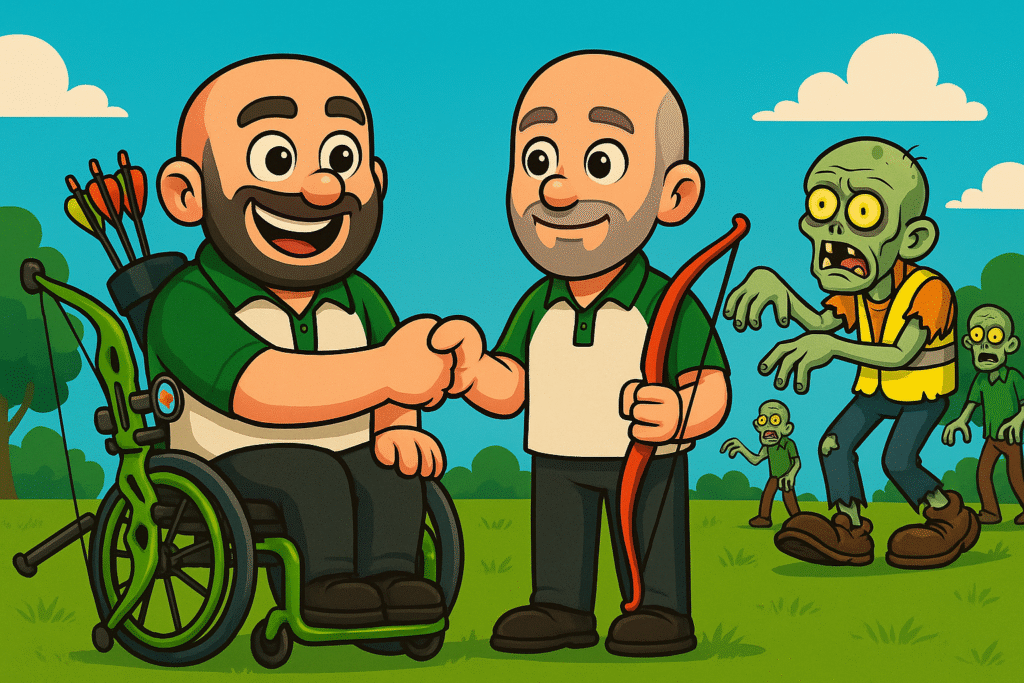
Freddy vs. the Zombie Apocalypse

Cartoon illustration of Freddy in a wheelchair fist-bumping Jonathan, with Colin the zombie and other unique zombies in the background.

The Disabled Prepper: Reflections from the Frontline (of Undeath & Community)

Cartoon illustration of Freddy in a wheelchair fist-bumping Jonathan, with Colin the zombie and other unique zombies in the background.

Last Saturday, I wasn’t battling the undead or scoring personal bests, I was doing something even more valuable: supporting Men’s Mental Health Week alongside my fellow archer Jonathan and the fantastic folks at Conwy Mind. We ran a community archery event at Colwyn Bowmen that reminded me that sometimes, survival isn’t about go bags or prep kits. It’s about being seen, heard, and connected.

But in the spirit of The Disabled Prepper, allow me to introduce what may become a recurring concern for this series: Colin.

Colin was probably a plumber. Possibly a pub quiz champion. Definitely undead.

You see, Colin is the unfortunate mascot of our hypothetical apocalypse. He lurches, he groans, and he wears a tattered hi-vis vest that still says “Safety First” — oh, the irony. Colin will be our ever-present reminder that when the world goes sideways, it’s not just the fast zombies you have to worry about… it’s the persistent ones with a dodgy gait and a fondness for “Braiiiiins”!

Let me introduce my apocalypse alter ego to you: Freddy the Arrowstorm.

Based on my now-expanding dossier, Freddy is armed with:

  • A green compound bow accurate enough to split mid-air midges
  • A Tactical Chair™ that handles field grass better than most cross-country bikes
  • A grin that says “I’ve got arrows, and I know how to use them”

Survival Strategy: Talk, Shoot, Listen

Archery has always been more than sport to me, it’s mental clarity. This event made it clearer than ever: pulling back a bowstring and letting go isn’t just good for target practice, it’s therapy. You could see it on the faces of every person who came along to try something new, share space with others, and walk away lighter.

If a zombie apocalypse ever hits, I want Jonathan on my team. The man can coach, encourage, reset a target boss, and offer a supportive word in a single breath. Together, we built more than a range, we built a place of calm mindful activity.

Wheelchair Mod Wishlist (Community Edition):

  • Cup holder for community teas
  • Built-in mental health awareness flag
  • Rotating armrest whiteboard for motivational quotes and doodles

Apocalypse Lessons Learned:

  • Connection is survival.
  • Encouragement is armour.
  • Laughter can disarm even the most stubborn fears (or Colin, bless him).

Help Me Keep Rolling

Whether I’m supporting community mental health or outrunning Colin and his undead mates, one thing stays the same: I need a chair that works as hard as I do.

That’s why I’m raising funds for a competition-grade wheelchair. One that won’t just carry me across fields, but through every opportunity to empower others.

If you’d like to support someone who believes archery can save lives (and maybe heads, in the apocalypse), please consider sharing or supporting my GoFundMe:

No pressure. But if community counts in a crisis, then we’re already halfway to surviving anything.

Freddy

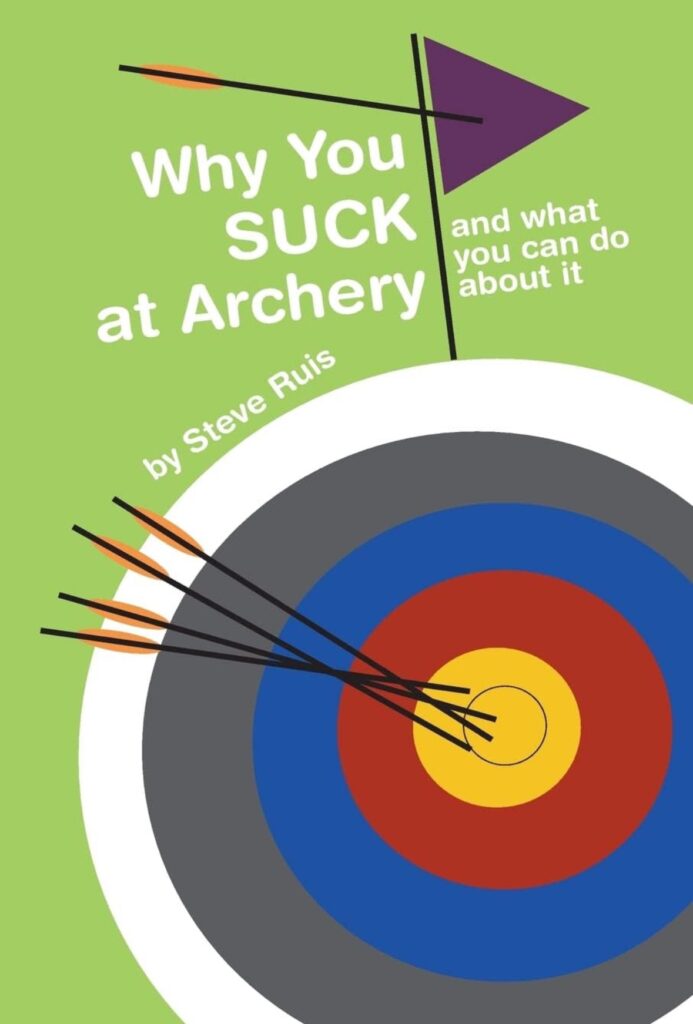
Book Review — Why You Suck at Archery by Steve Ruis

Grab your copy at Amazon

At-a-Glance

PagesFirst publishedISBN-13Format(s)Goodreads rating*
1101 Nov 2012978-0984886036Paperback & Kindle4.16 / 5

*Rating snapshot, May 2025

What’s Inside the Quiver

  1. “28 Ways You’re Sabotaging Your Shot” – a rapid-fire rundown of the most common form faults and kit sins Ruis sees as a Level 4 USA Archery and NFAA Master Coach. No sugar-coating, just straight talk and fixes you can try at your next session.
  2. “The Head-Game” – drills and mindset tweaks to keep the gremlins quiet when you’re on the shooting line. Think of it as mental SPT for grown-ups.

Hits

  • Bite-sized fixes. Each fault gets a concise explanation and a remedy you can test in the very next end — perfect for practice notebooks.
  • Coach’s credibility. Decades on the line and in the coaching tent keep the advice grounded in real-world experience, not armchair theory.
  • Portable price & length. About a tenner and just 110 pages — lighter than a dozen pin nocks and small enough for the top pocket of your bow case.

Near-Misses

  • No full form guide. True beginners will still want a more structured “how to shoot” manual alongside it.
  • Sparse illustrations. Visual learners may wish for more photos or diagrams — though the brevity keeps the cost down.

Who Will Get the Most from It?

  • Improvers stuck at the same classification or handicap.
  • Coaches hunting for fresh ways to explain stubborn habits.
  • Fans of Ruis’ other titles (The Archery Drill Book, Precision Archery) who want a faster, cheekier read.

My Take

I read Why You Suck at Archery during my coaching course. It’s not a magic pill, but it is the brisk kick in the butt (see what I did there? 🤪) we all need from time to time.

Freddy Score: ★★★★☆ (4 / 5)

Ready to stop sucking?

👉 Order your copy through Amazon and start turning “flyers” into golds.


PS: If you’d like to back my para-archery journey, please consider donating to my GoFundMe campaign. Every bit helps — thank you!

Disclosure: As an Amazon Associate I earn from qualifying purchases. If you buy via the link below, a few pennies help keep this blog alive and fund my next para-archery shoot — at no extra cost to you. Thanks for the support!

Chasing Arrows in Clwyd: A PB at the Welsh Whit Western

Sunday saw me heading out to Clwyd Archers for the “Welsh Whit Western” and what a day it turned out to be. A classic mix of Welsh optimism and meteorological suspense. The forecast teased rain all week, and while the clouds hovered like they meant business, they kindly held off. Instead, we got patchy sun and enough blustery wind to keep things “interesting”.

The round itself? Western distance scoring. Long, deliberate shots, repeated with enough arrows to leave a definite imprint on your shoulders and your memory.

But here’s the headline: I hit a personal best of 814 and this one felt earned. Every arrow was a contest, especially as the wind decided to whip across the field like an invisible prankster. It wasn’t aggressive, but it was cheeky enough to push you off course if your focus wavered.

There’s something deeply satisfying about finding your rhythm in those conditions. My setup did its job, and more importantly, I stayed present, aiming off, focussing, maintaining my shot process, and letting the bow do what it’s built for.

Huge credit to Clwyd Archers, too. The shoot was smoothly run, friendly, and had exactly the kind of welcoming atmosphere you hope for when you rock up at an open round. Banter on the line, quick-witted scoring jokes, and a field full of people quietly rooting for each other, it reminds you why archery isn’t just about numbers on a target.

Pushing for Progress – With a Little Help

Hitting a PB like this is a brilliant reminder of how far I’ve come, not just in archery, but in my journey since becoming a wheelchair user. Archery has given me focus, community, and a sport where precision matters more than how far I can walk.

But to keep chasing those scores and attending competitions like this, I need a wheelchair that can keep up with me.

If you’ve enjoyed following my journey or feel inspired by what sport and stubbornness can achieve, please consider supporting my GoFundMe campaign. Every donation goes towards getting a wheelchair that will allow me to train, travel, and compete with greater independence and efficiency.

Whether you chip in or just share the link, it genuinely helps me keep rolling, towards targets, toward tournaments, and toward the next personal best.

Thanks as always for reading, supporting, and being part of this journey.

Double the Arrows, Double the Fun?

There’s something quietly thrilling about packing up the gear for a double WA720—especially when the venue is North Cheshire Bowmen. You know it’s going to be a long day, but there’s an odd comfort in that sort of commitment. Early start, two 720 rounds back-to-back, and the unspoken camaraderie of archers pretending they’re not slowly stiffening with every end.

WA720s suit me, I’ll admit it. There’s a rhythm to the format—six arrows, end after end, that allows you to settle into a groove. For compound shooters like me, that 50m mark is our battleground. Every shot a test of focus, form, and whether or not your last adjustment to the sight was wisdom or wishful thinking.

Tomorrow promises to be a full test: endurance, hot weather, and no doubt that cheeky Cheshire wind playing mischief with stabilisers. But I’m ready. The Doinker’s on, arrows are fletched, and I’ve got just enough caffeine and stubbornness to carry me through both rounds.

These events aren’t just about the scores though. They’re about the banter on the line, supporting one another, hearing the odd “that should have been an X,” and realising how small the world of archery is when someone says, “Weren’t you at that shoot in Rhyl last year?”

As always, I’m aiming for consistency, not perfection. If I walk away with a strong second round (when everyone else is flagging), I’ll count that as a win. If not, I’ll at least walk away with stories, a sunburned nose, and the knowledge that I showed up, gave it everything, and hopefully didn’t leave too many arrows in the 8 ring.

See you on the line.

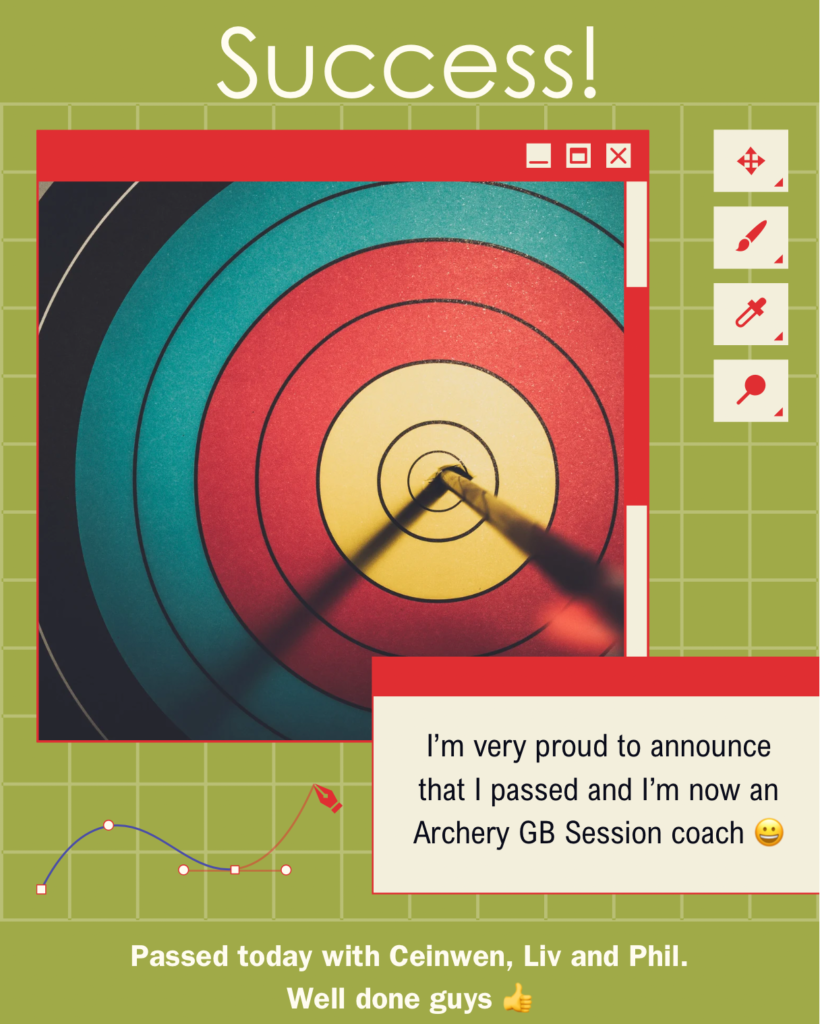
Coaching Milestone: Archery GB Session Coach Status Achieved

I’m delighted to share some brilliant news – as of today, I’ve officially passed the Archery GB Session Coach Award!

Even better, I had the privilege of completing the assessment alongside three fellow members of Colwyn Bowmen – Ceinwen, Liv, and Phil. It made the day even more special to cross the line with friends who’ve shared the same journey.

This is a big step forward in my archery story – not just as a shooter, but now assomeone who can help guide beginners on their first steps into the sport. I’ve particularly enjoyed exploring ways to adapt my coaching style to account for my own post-op limitations, but it’s been so rewarding. Being able to teach and encourage others, knowing how much the sport has done for me, feels like coming full circle.

Massive congratulations to Ceinwen, Liv and Phil – we did it! And thank you to Jonathan and Nick, who’s offered support, encouragement, and guidance along the way.

Onwards and upwards!

Neolithic Archery: The Oldest Bowstrings and the Ultimate Throwback to Our Sport!

Ever wondered what the earliest archers were like?

No, they didn’t have carbon fiber limbs, precision-cut fletchings, or fancy compound bows—but they were still absolute legends with a bow and arrow! And thanks to a fascinating new study published in Scientific Reports, we now have fresh evidence of some of the earliest archers in human history—and, let’s just say, they were shooting long before anyone was debating recurve vs. longbow.

The Oldest Bowstrings Ever Found (No, Really!)

Archaeologists working at Cueva de los Murciélagos (which, in a dramatic twist, translates to “Cave of the Bats”—because of course, every great discovery needs a cool name) in Spain have uncovered what might be the oldest bowstrings known to science. These sinew-based strings date back over 7,000 years—meaning early Neolithic archers were already stringing up bows while woolly mammoths were still making their final exit.

Just imagine: while you’re carefully waxing your bowstring before a shoot, our ancestors were painstakingly crafting sinew cords to take down prey or defend their turf. And you thought your pre-tournament bow tuning was intense!

Ancient Archery Materials: No Synthetic Limbs Here!

Unlike today’s laminated risers and fiberglass-backed bows, these Neolithic archers made do with olive wood (Olea europaea) and reeds (Phragmites species). Now, that’s an archery setup with a real connection to nature. The study highlights how these early bowyers carefully selected materials for durability and flexibility—long before there were archery forums debating the best wood for a bow.

Their craftsmanship shows a deep understanding of materials and technology, proving that archery wasn’t just a means of survival; it was a refined skill, passed down through generations. (Which, let’s be honest, is something any archer today can relate to—except we pass down wisdom about nocking points and draw weight.)

What This Means for Archers Today

So, why should we care about some old bowstrings and wooden arrows? Because this discovery connects us to the very roots of our sport. Whether you’re a target archer, bowhunter, or just someone who loves the feel of a well-tuned bow, you’re continuing a tradition that goes back at least 7,000 years—and probably much, much further.

The next time you nock an arrow, take a moment to appreciate that you’re part of something ancient. (And if your string ever snaps mid-shot, just remind yourself—at least you don’t have to go hunting for sinew to replace it.)

Final Thoughts (and a Dad Joke, Because Why Not?)

This study is a game-changer in our understanding of early archery. It proves that our ancestors were skilled, resourceful, and maybe just a little bit obsessed with perfecting their bows—just like we are today.

And finally, because I promised:

Why did the Neolithic archer break up with their bow?

Because they just couldn’t string things along anymore!

(Okay, okay, I’ll see myself out.)

Sources:

Nature Scientific Reports: The Oldest Known Bowstrings and Neolithic Archery

What do you think—could you survive as a Neolithic archer? Let me know in the comments!

Enhancing Inclusivity in Archery: Insights from the Latest Neurodiversity Research

Introduction

Archery has long been a sport where precision, patience, and focus are key. But for neurodivergent archers—those with conditions such as autism, ADHD, or dyslexia—the experience can be vastly different. Some may find unique advantages, such as heightened focus in controlled environments, while others face barriers like sensory overload or challenges with traditional coaching methods.

Recognising this, Archery GB, in partnership with The Liverpool Centre for Olympic Research on Inclusion (LCORI) and Access Sport, has launched a study aimed at understanding how neurodivergent athletes experience the sport. The goal is to make archery more accessible, enjoyable, and successful for all who want to participate.

This post explores what this research means for the sport, why inclusivity matters, and how both neurodivergent archers and coaches can get involved.

Understanding the Neurodiversity Research Project

Archery GB and LCORI are currently collecting real-world insights from neurodivergent archers (both diagnosed and self-identified) and coaches working with neurodivergent athletes.

By gathering first-hand experiences, the research aims to:

  • Identify barriers that neurodivergent athletes face in archery
  • Highlight opportunities to make coaching, training environments, and competitions more inclusive
  • Provide practical recommendations to ensure neurodivergent individuals can thrive in the sport

Coaches, in particular, will play a crucial role in shaping the findings by sharing their experiences in working with neurodivergent archers—what works, what doesn’t, and what needs improvement.

For those interested in contributing, Archery GB has launched surveys for both archers and coaches to share their experiences. All responses are confidential and will be used exclusively by the LCORI research team.

Take the survey here: Click Here

Why This Research Matters

For too long, sports—including archery—have operated under a one-size-fits-all coaching model, which often doesn’t cater to the needs of neurodivergent participants. However, research has shown that embracing neurodiversity can enhance performance, engagement, and retention in sports.

Some neurodivergent athletes report:

  • Increased focus during repetitive, structured tasks (like archery shooting sequences)
  • Improved performance when given clear, direct instructions rather than abstract coaching styles
  • Better engagement when training environments reduce unnecessary sensory distractions

However, challenges remain, such as:

  • Sensory sensitivity, such as discomfort with loud noises at competitions
  • Difficulties with social interaction in traditional coaching setups
  • Struggles with executive function, such as remembering multi-step sequences

By recognising these factors, coaches and clubs can create a more inclusive environment that plays to neurodivergent strengths while reducing unnecessary barriers.

Steps Towards an Even More Inclusive Archery Community

Beyond this research, Archery GB and Access Sport have developed a Neurodiversity Workshop to educate coaches, club officials, and volunteers. The workshop covers:

  • Understanding autism, ADHD, and other neurodivergent conditions
  • Practical coaching adaptations to improve engagement
  • Frameworks like the Inclusion Spectrum and the STEP model, which help tailor training sessions

Additionally, coaches can:

  • Use clear, structured instructions rather than abstract explanations
  • Allow flexibility in routines for neurodivergent athletes who may struggle with rigid structures
  • Create a predictable environment by minimising unnecessary noise, distractions, or sudden changes
  • Encourage self-regulation techniques, such as allowing timeouts or quiet spaces when needed

The goal isn’t to lower standards but to provide different routes to success—something that ultimately benefits all athletes, not just neurodivergent ones.

How to Get Involved

For archers and coaches who want to support this movement, here’s how you can help:

  1. Complete the Neurodiversity Study Survey – Your experiences are invaluable to shaping the future of inclusive archery. Take the survey here: Click Here
  2. Join a Neurodiversity Workshop – If you’re a coach or club official, consider attending Archery GB’s workshops to learn more about supporting neurodivergent athletes.
  3. Share Your Experiences – If you’re a neurodivergent archer, share your journey in the comments below. What’s worked for you? What changes would you like to see?
  4. Encourage Open Conversations – If you’re in an archery club, start discussions about how training environments can be improved for neurodivergent members.

Conclusion

I believe that archery is one of the most inclusive sports in the world, but only if it continues evolving to meet the needs of all participants. The neurodiversity research project is a significant step towards ensuring that every archer, regardless of how their brain works, feels supported, empowered, and able to reach their full potential.

Let’s continue to make archery a place where everyone can thrive.

Exciting News: Personal Development Grant Awarded from Sport Conwy

Red background with white lettering saying Sport Conwy

📣 Exciting News! 🏹✨

I am absolutely thrilled to announce that I have been awarded a grant under the “Sport Conwy Personal Development Grant Scheme“!  This grant will assist me in improving my archery skills to the next level and compete in more National Archery competitions! 🏆

I cannot express how pleased I am to have been awarded this grant.  Thanks to the generosity of Sport Conwy, I will now be able to invest further in equipment, coaching, and training. This support will undoubtedly help me improve my technique and overall performance, ensuring I stand a chance against some of the nation’s most talented archers. 🎯💪

I also want to express my gratitude to all my family, friends, and fellow archers who continue to support me physically, emotionally and financially through Just Giving.  Your unwavering support and encouragement are invaluable, and I couldn’t have come this far without you. 🙌❤️

Once again, thank you, Sport Conwy, for this grant. I am truly honored and can’t wait to make the most of this opportunity to bring my best to the archery field! 🏹✨

#SportConwy #PersonalDevelopmentGrant #ArcheryJourney #ArcheryGB #Para-ArcheryAssociation